
What is methylene blue?
Methylene blue is a deep-blue synthetic compound that has spent nearly 150 years moving between worlds — first a textile dye, then one of the earliest synthetic medicines, and now a focus of research into how our cells make energy. Here’s an honest, jargon-free look at what it actually is.
A 150-year-old molecule
Chemically, methylene blue (methylthioninium chloride) is a redox-active dye — meaning it readily accepts and donates electrons, shifting between a coloured and a colourless form. That single property is behind almost everything interesting about it, from its use as a biological stain to its role in medicine and the cellular-energy research happening today.
It’s also one of the most studied synthetic compounds in existence, with a safety and pharmacology record stretching back over a century.
How methylene blue carries electrons
Inside every cell, tiny structures called mitochondria generate energy by passing electrons down a chain of carriers — the electron transport chain — to ultimately produce ATP, the body’s energy currency. Researchers describe methylene blue, at low concentrations, as an alternative electron carrier: it can pick up electrons and hand them further down the chain, in effect offering a parallel route when the normal one is under strain.
At those low concentrations it also behaves as an antioxidant. This is why concentration matters so much: methylene blue’s behaviour flips with dose — supportive in small amounts, the opposite at high ones. It’s a textbook example of why “more” is not better.
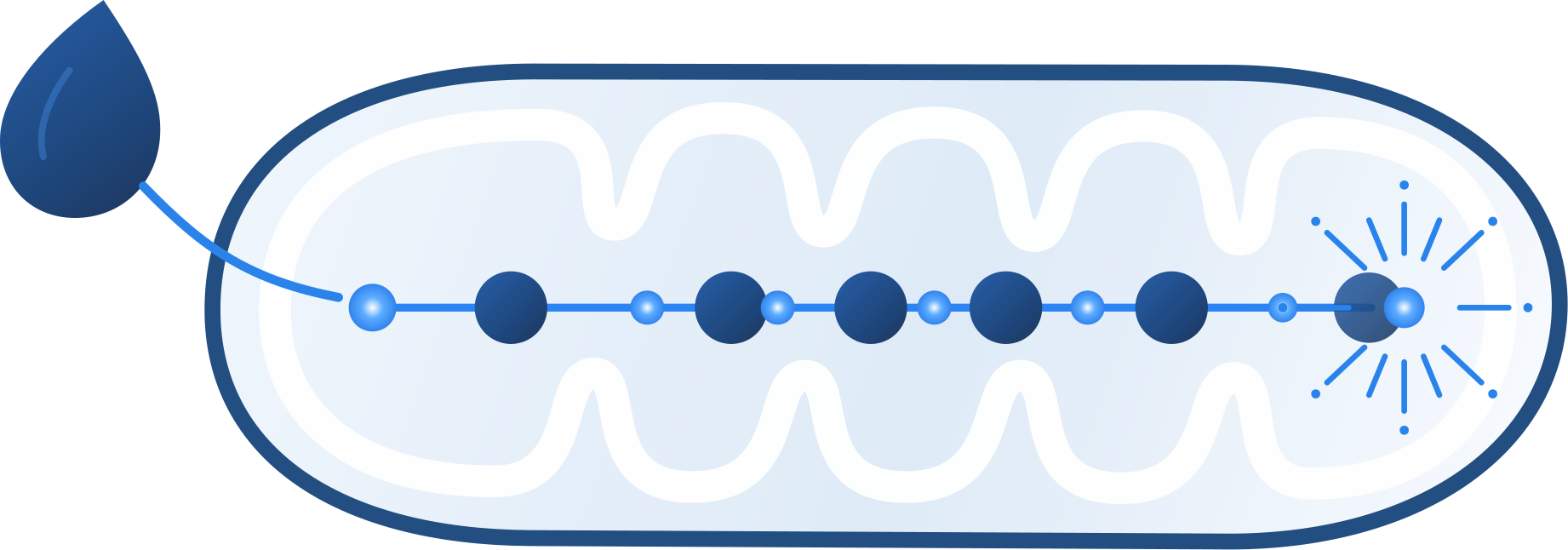
This describes a mechanism studied in laboratory and cellular research. It is not a claim that any product diagnoses, treats, cures or prevents disease.
The chemistry, in full+
Methylthioninium chloride is a phenothiazine-derived cation. It cycles between an oxidised, blue form (methylene blue) and a reduced, colourless form (leucomethylene blue), and that reversible redox behaviour is the basis of everything below.
In mitochondrial preparations it accepts electrons from NADH and donates them to cytochrome c, providing a route that bypasses complexes I and III of the electron transport chain. The effect is concentration-dependent. At low concentration it cycles electrons and reduces the electron leakage that produces superoxide; at higher concentration the same redox activity reverses and becomes pro-oxidant. This hormetic profile is why concentration and accurate measurement are treated as the primary variables — more is not better, and the chemistry is the reason.
Methylthioninium chloride is also a reversible inhibitor of monoamine oxidase A. That is the basis of its interaction with serotonergic medicines, covered on Is methylene blue safe?.
These are findings from laboratory and cellular research on the molecule. They are not claims about any product.
The research behind this
These are the studies that underpin the mechanism described above, summarised in plain terms with links to the papers.
Methylene blue acted as an alternative electron carrier in cultured neurons
In cultured neurons, methylene blue accepted electrons from NADH and passed them to cytochrome c, bypassing complexes I and III. A plain summary of Wen et al., J Biol Chem 2011.
Low-concentration methylene blue delayed senescence in cultured human fibroblasts
In cultured human fibroblasts, nanomolar methylene blue extended replicative lifespan by over 20 population doublings and raised complex IV activity 30%. A plain summary of Atamna et al., FASEB J 2008.
Not all methylene blue is the same
The same chemical name covers wildly different qualities. Industrial and dye-grade methylene blue is made for staining and manufacturing — it can carry heavy-metal contaminants and impurities that have no place in anything you’d take. Pharmaceutical (USP) grade is held to a far higher standard of purity.
A 1% aqueous solution simply means 1 gram of methylene blue per 100 ml of water — 10 mg/ml — which makes precise, low-dose measurement by the drop straightforward, without handling raw powder. It’s the form that balances accuracy and ease of use.
Common questions
What is methylene blue made from?+
Methylene blue is a synthetic compound; it does not occur in nature. Its chemical name is methylthioninium chloride, a phenothiazine derivative first synthesised by Heinrich Caro at BASF in 1876. Blu Brain’s 1% solution contains two ingredients: methylthioninium chloride to USP specification, dissolved in Grade A deionised water.
Is methylene blue natural?+
No. Methylene blue is entirely synthetic and has been since it was first made in 1876. It is not extracted from any plant, mineral or animal source. Its colour is intrinsic to the structure of the molecule.
What does 1% methylene blue mean?+
A 1% w/v aqueous solution contains 1 gram of methylthioninium chloride per 100 ml of water, which is 10 mg per millilitre. A dropper dispensing roughly 0.05 ml per drop delivers about 0.5 mg per drop. The 1% form allows small quantities to be measured accurately without handling powder.
What is methylene blue used for?+
Clinically, methylthioninium chloride is a licensed medicine given intravenously in hospital to treat methemoglobinemia, and it appears on the WHO Model List of Essential Medicines. It is also used as a stain in histology and microbiology, and was originally a textile dye. Those are uses of the medicine and the laboratory reagent. Blu Brain is a food supplement, not a medicine, and is not intended to diagnose, treat, cure or prevent any disease.
Get the tested blue — or read on
Methylene Blue 1%, done properly
UK-made, USP-grade, Eurofins-tested, in light-protective cobalt glass.
Shop Methylene Blue 1%